


A Directory of Worldschool hubs for nomad families and life-long learners
April 9, 2019
Community Fundamentals: Overcoming hopes and fears to build a healthy community
April 19, 2019
As we work together to create an alternative style secondary school here in the Spanish Pyrenees, we’ve had to give a lot of serious thought to what pedagogical philosophy to follow. We recently put together and shared a list of 11 Models of Alternative Education, which includes schooling models like Montessori and Waldorf, to name a couple. But one idea that wasn’t included in that article was the Theory of Multiple Intelligences.
Howard Gardner first proposed this concept in his 1983 book Frames of Mind: The Theory of Multiple Intelligences. The premise of the book says that humans exhibit a whole spectrum of 8 or 9 intelligences. And while traditional education models focus almost exclusively on verbal and mathematical intelligence, there are several other facets of intelligence that comprise a complete and well-developed human.
This idea of multiple intelligences plays a vital role in the teaching methods practiced at our children’s elementary school, and we consider it crucial to providing a holistic education that recognizes the entire person. It’s all too common in conventional schools for students with fabulous artistic or musical intelligence, for example, to be passed over or even disparaged because they don’t necessarily excel in math or reading.
By recognizing the rainbow of talents and abilities, children are able and encouraged to explore a greater range of interests, and to pursue and develop a more diverse set of skills. In the end, the students are more likely to discover their greatest strengths and passions, leading to a healthier, happier and more confident class of people.
The following list of covers the 9 intelligences, how they are defined, and how we propose to nurture them through various activities in our “dream school”.
1. Linguistic intelligence (“word smart”)
- To think in words and to use language to express and understand complex meanings
- Sensitivity to the meaning of words as well as the order of words, their sounds, rhythms, and inflections
- To reflect on the use of language in everyday life
Linguistic Sensitivity: Skill in the use of words for expressive and practical purposes
Reading: Skill in reading
Writing: Ability and interest in writing projects such as poems, stories, books, or letters
Speaking: Skill in oral communication for persuasion, memorization, and description
Implementation:
- having regular discussions about current events
- presenting projects in front of the community (school community or even greater community for bigger projects – TED talks)
- learning and using different languages
- writing essays, writing grants, write project outlines, writing poems/books, etc
- having a library available “Little Library project”
- researching projects/workshops, communicating with presenters and school
- watching TED talks, have discussion afterwards
- inviting people to give talks, have discussions afterwards
- drama workshops, poetry slams
- writing blogs for the school website
- writing/editing website content (events, etc)
- writing school history (historian)
2. Logical-mathematical intelligence (“number/reasoning smart”)
- To think of cause and effect and to understand relationships among actions, objects, or ideas
- To be able to calculate, quantify, consider propositions, and perform complex mathematical or logical operations
- Inductive and deductive reasoning skills, as well as critical and creative problem-solving
Problem Solving: Skill in organization, problem solving, and logical reasoning; curiosity and investigation
Calculations: Ability to work with numbers for mathematical operations such as addition and division
Implementation:
- talk about current events and how they relate to what happened in the past (history)
- school finances (writing a budget, checks and balances of projects, getting estimates, estimating requirements)
- coding
- puzzles
- planning and construction (measuring & calculation)
- cooking/baking (measuring & estimating)
- developing and maintaining a school website
- chess club
3. Spatial intelligence (“picture smart”)
- To think in pictures and to perceive the visual world accurately
- To be able to think in three dimensions and to transform one’s perceptions and recreate aspects of one’s visual experience via imagination
- To work with objects
Imagery: Use of mental imagery for observation, artistic, creative, and other visual activities
Artistic Design: To create artistic designs, drawings, paintings, or other crafts
Construction: To be able to make, build, or assemble things
Implementation:
- design of the school (painting walls, choosing floors, interior design, landscaping design)
- design of a website
- photography
- design of school materials (including worksheets as well as marketing material)
- integration of an artist atelier on the school grounds where students can visit, observe and participate (artist residencies)
- construction
- sewing
4. Bodily-Kinesthetic intelligence (“body smart”)
- To think in movements and to use the body in skilled and complicated ways for expressive as well as goal-directed activities
- Sense of timing and coordination
Physical Skill: Ability to move the whole body for physical activities such as balancing, coordination, and sports
Dancing, Acting: To use the body in expressive, rhythmic, and imitative ways
Working with Hands: To use the hands with dexterity and skill for detailed activities and small work
Implementation:
- regular yoga and PE classes
- sports curriculum including swimming, hiking skiing
- hula hooping, unicycle, mountain biking, dance, drama workshops
- art workshops (clay, sculpture, finger-paint, etc)
- fine motor activities
5. Musical intelligence (“music smart”)
- To think in sounds, rhythms, melodies, and rhymes
- To be sensitive to pitch, rhythm, timbre, and tone
- To be able to recognize, create, and reproduce music by using an instrument or the voice
- To listen actively
Musical Ability: Awareness of and sensitivity to music, rhythms, tunes, and melody
Instrument: Skill and experience in playing a musical instrument
Vocal: A good voice for singing in tune and along with other people
Appreciation: Actively enjoys listening to music
Implementation:
- offer music classes through local music school
- host musicians/ bands (concerts)
- make instruments
- music workshops
- make music together regularly
- incorporate music in daily activities (while cooking, yoga, construction)
6. Interpersonal intelligence (“people smart”)
- To think about and understand another person
- To have empathy and recognize distinctions among people and to appreciate their perspectives with a sensitivity to their motives, moods, and intentions
- Includes interacting effectively with one or more people among family, friends, or working relationships
Understanding People: Sensitivity to and understanding of other people’s moods, feelings, and point of view
Getting Along with Others: Able to maintain good relationships with other people, especially friends and siblings
Leadership: To take a leadership role among people through problem solving and influence
Implementation:
- democratic/sociocratic school
- morning circle
- “student-teacher” counseling sessions (Big Brothers, Big Sisters)
- team work (projects)
- conflict resolution in the community through judges
- community work (cleaning forest or beaches, visit elderly, have a bake sale, RAKs)
- leadership through project work
- running a restaurant/bistro/zero waste store/farmers market
- “subotniks” work weekends to fix something in the greater community (guerrilla gardening, pulling weeds, picking up trash, putting up a little library, etc)
7. Intrapersonal intelligence (“self smart”)
- To think about and understand one’s self
- To be aware of one’s strengths and weaknesses and to plan effectively to achieve personal goals
- Includes reflecting on and monitoring one’s thoughts and feelings and regulating them effectively
Knowing Myself: Awareness of one’s own ideas, abilities; personal decision-making skills
Goal Awareness: Awareness of goals and self-correction and monitoring in light of a goal
Managing Feelings: Ability to regulate one’s feelings, moods and emotional responses
Managing Behavior: Ability to regulate one’s mental activities and behavior
Implementation:
- reflect on self regarding strengths and weaknesses (based on multiple intelligences)
- goal setting (personal & school/project related) – help and regular check-in from guide/teacher/mentor
- keeping a diary/documenting project processes
- decision making (regarding: goals, projects, workshops, teachers/guides, etc)
- emotional control during arguments (morning circle, discussions after TED talks or presentations)
- debate club, watch debates
8. Naturalist intelligence (“nature smart”)
- To understand the natural world including plants, animals, and scientific studies
- To be able to recognize and classify individuals, species, and ecological relationships
- To interact effectively with living creatures and discern patterns of life and natural forces
Animal Care: Skill for understanding animal behavior, needs, characteristics
Plant Care: Ability to work with plants, (i.e., gardening, farming, and horticulture)
Science: Knowledge of natural living energy forces, including cooking, weather, and physics
Implementation:
- garden to grow food
- tend to chickens, dogs and other community animals
- take care of school plants and community landscaping
- regular hikes with geologists, herbalists, etc
- local medicinal plants
- pressed flower books
- make your own paint
- cooking for bistro (chemistry)
- construction (physics)
- gardening (weather)
- net zero school goals
- climate change actions
9. Existential intelligence (Spiritual intelligence)
Many lists only include 8 intelligences, skipping this one. But those that include all 9 intelligences often recognize Spiritual intelligence as the most important.
- Having a sense of what gives meaning and purpose to your life
- Having a sense of right and wrong, or ethics
- Having a sense of mutual respect, tolerance, acceptance and humility
- Having a natural curiosity and inclination to ask “why”
- Seeing things holistically, as interconnected and interdependent
Implementation:
- regular meditation
- open discussion of moral and philosophical questions
- studying fables, fairy tales, mythology and world religions
- role playing exercises
- reading and performing dramas based on books like The Diary of Anne Frank, To Kill a Mockingbird, The Oresteia
Read On
To learn more about our quest for alternative education, check out these articles:
- A Directory of Worldschool hubs and communities
- 11 Models of Alternative Education
- New Education: How we found a sensible school in Catalonia
- New Education: Out of the classroom and into the wild
- The Future of Education: Location Independent Schooling
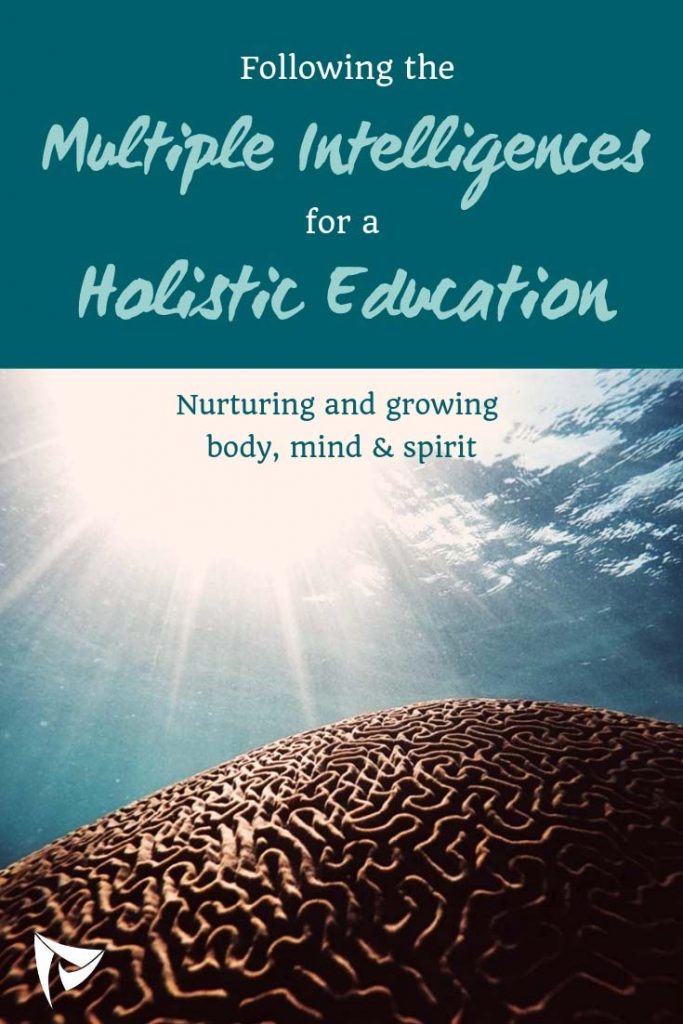
Photo Credit: Brain Coral (Unsplash)





1 Comment
This is amazing! Beautifully conceived and constructed